The Blending Problem
Florida processing oranges are harvested roughly from October through June. Early Hamlin juice generally has lower soluble solids and color than late Valencia juice. Each incoming harvest lot was measured for Brix, color, and ratio — the relationship between soluble solids and acidity.
The processor made one receiving decision for each harvest week: which one of the eight tanks should receive this week’s juice? It also made a shipping decision in every week of the year: which tank should supply that week’s outgoing load? An incoming lot was directed to one tank, not all eight; an outgoing shipment likewise drew from one selected tank.
Those decisions could not be optimized independently. Adding a low-color Hamlin lot to the wrong tank might leave no tank at specification for a later shipment. Using a premium Valencia blend too early might remove the only inventory capable of correcting a later tank. The annual plan had to ensure that, in each of 52 shipping weeks, at least one tank would be blended to the customer’s required Brix, color, and ratio.
For the illustration, an outgoing shipment is considered in range at 11.8-12.2 Brix, color 36-38, and ratio 14.5-15.5. Those are explanatory example limits rather than the client’s actual contract specifications. Each tank is marked in range or with a representative reason it cannot supply the shipment. Tank 6 is selected for the truck because its Brix, color, and ratio all fall within the delivery window.
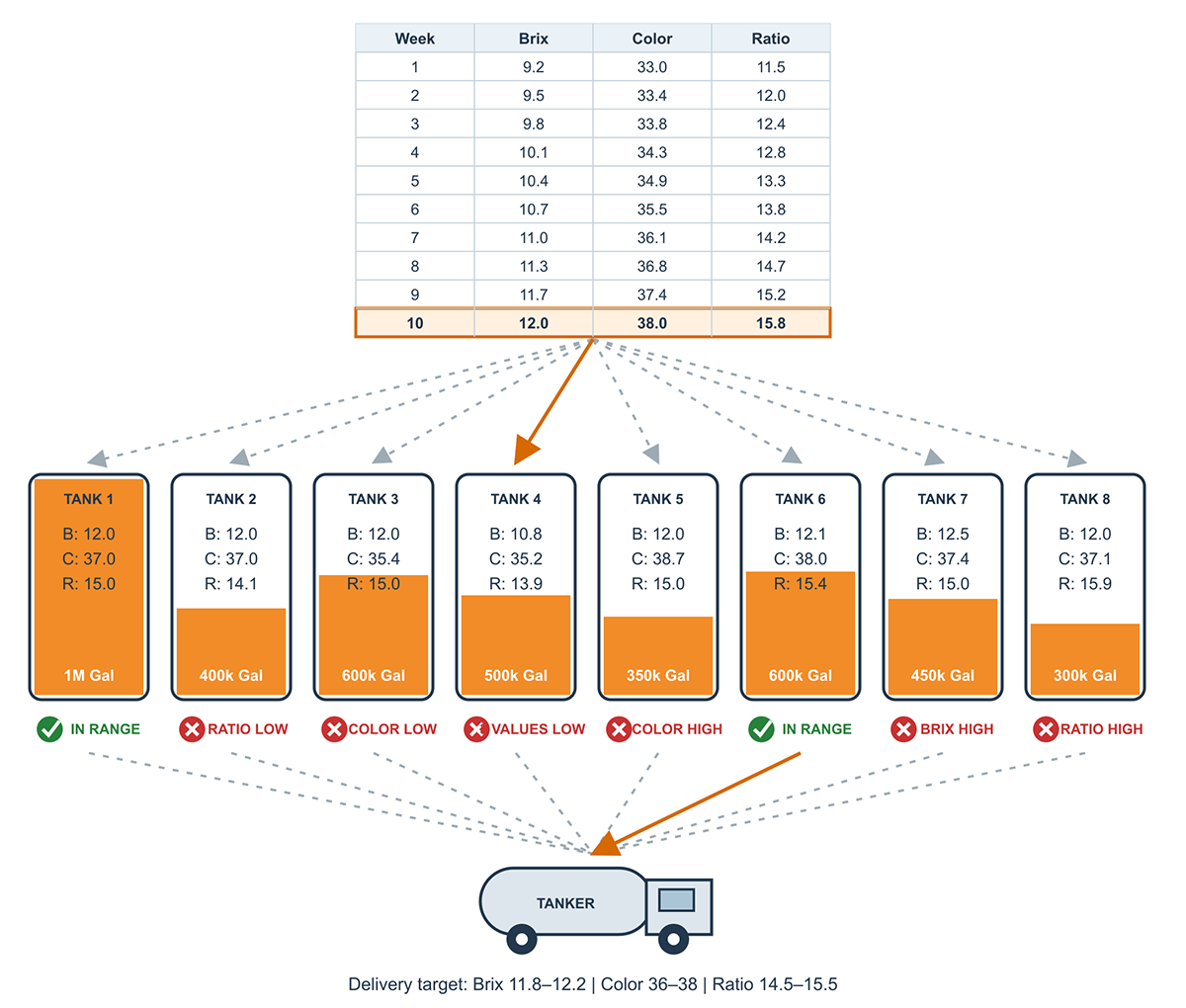
One receiving tank is selected for Week 10; one in-range tank supplies the outgoing load.
Weather and Harvest Timing
Bulk aseptic storage bridges a seasonal harvest to year-round demand. Frost risk complicates the supply forecast. Freeze injury can reduce juice content, cause fruit drop, and leave damaged fruit drying during subsequent weeks. Because citrus does not continue ripening after harvest, picking early to avoid a forecast freeze may protect quantity while sacrificing Brix, ratio, or color. Waiting may improve maturity while increasing exposure to loss.
Optimizing Incoming Harvest and Outgoing Deliveries
The system combined projected harvest volumes and characteristics, current tank inventories, customer specifications, storage capacity, blending rules, and penalties for missing contracted requirements. It constructed the receiving and shipping decisions together across the planning horizon.
The model’s value was temporal. It did not merely find a tank that could accept today’s harvest or satisfy today’s shipment; it preserved enough correctly blended inventory to keep a feasible shipping option available week after week.
Additionally, by minimizing the quantity of high-value juice to achieve NFC OJ delivery specs, a larger quantity of the pricey Valencia varietal juice was reserved for sale at a premium price.
See other Agribusiness: Sugar · Livestock Feed · Enzymes · Milk