Which Fields Are Most Profitable to Replant?
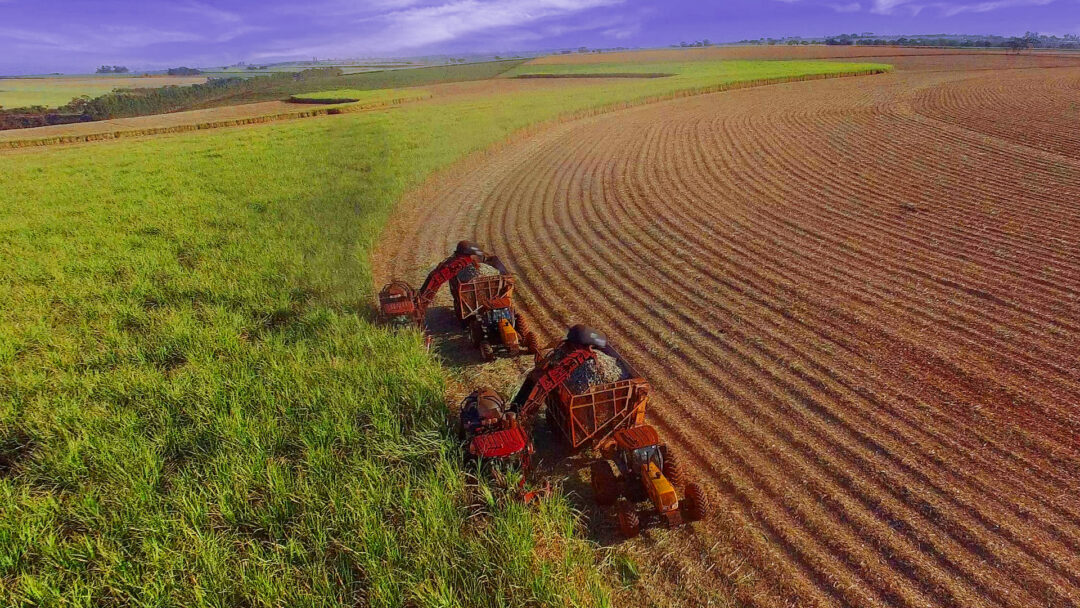
After the first plant-cane harvest, the roots can produce successive ratoon crops, avoiding the cost and downtime of replanting. Florida cane fields are harvested repeatedly until plant population and yield decline too far; an average cycle is often one plant-cane crop followed by two ratoons, although profitable fields may remain longer.
Published agronomic research has represented ratoon decline with linear functions, so a straight-line example is a legitimate simplification. The real process is not universally linear, however. Cultivar, soil, drainage, weather, harvest damage, pests, disease, and management can make a field decline slowly, abruptly, or irregularly. Ratoon-stunting disease alone can reduce yield without obvious symptoms.
A weaker field might yield 25, 23, and 21 tons of cane per acre before replanting restores it to 25. A strong field might yield 40, 36, 32, 28, 24, and 20 before renewal restores it to 40. The vertical jump makes the replacement value visible.
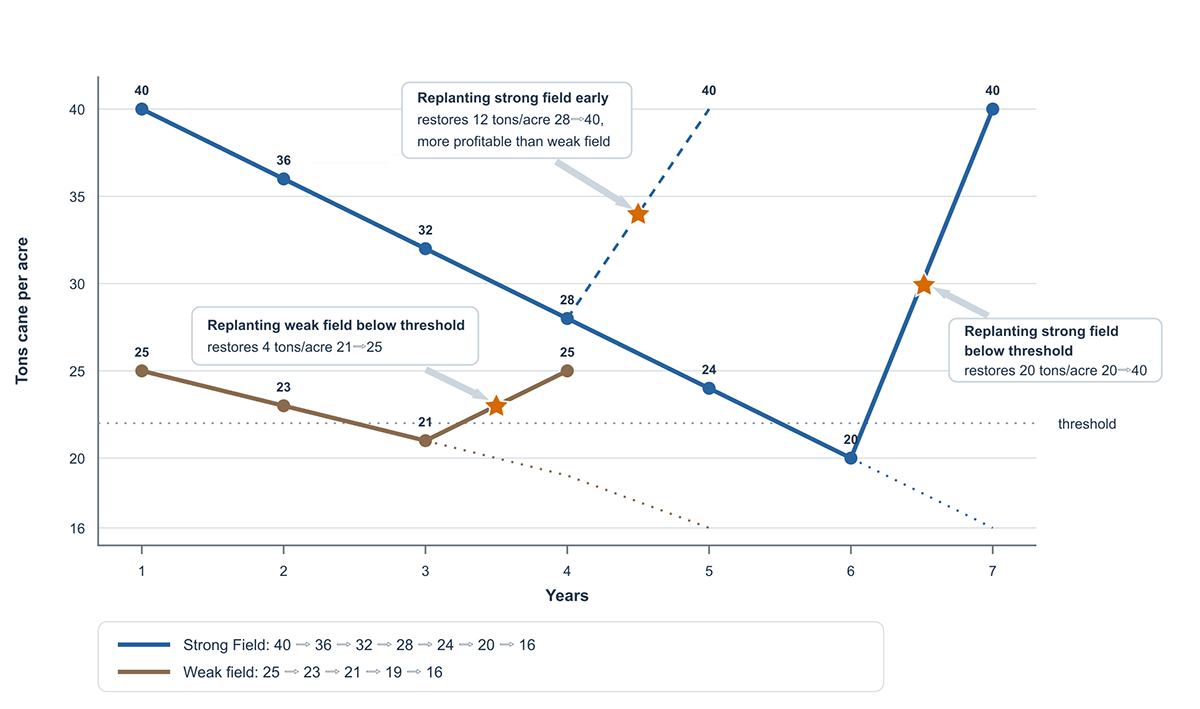
Imagine a policy of replanting every field producing fewer than 22 tons of cane per acre. Such a policy would renew the weak field after year three but wait to renew the strong field after year five. However if only one field can be replanted, a cost-benefit analysis shows the stronger field is more profitable to replant sooner rather than waiting for its decline below a threshold.
Replacing the threshold with a smarter rule wasn’t enough. Even “replant the field that will gain the most tonnage” would still optimize the wrong thing.
The objective wasn’t to grow the most sugarcane. It was to make the most economically valuable sugar.
Once we modeled that distinction, what initially looked like a crop-management problem became a much larger optimization problem.
Yield: A Ton of Cane Is Not a Ton of Sugar
Tons of cane per acre was only an intermediate measure. The company ultimately sells sugar, not sugarcane, and the economics of getting from one to the other varied substantially from field to field.
One important variable was yield: the percentage of harvested cane that ultimately becomes recoverable sugar. Increasing tonnage and increasing yield may produce similar increases in sugar output, but they do not have similar economics. If a field produces twice as much cane, approximately twice as much material must be harvested, loaded, transported, and processed. If instead the same tonnage of cane contains twice as much recoverable sugar, revenue can increase dramatically without doubling those tonnage-dependent costs.
That distinction becomes even more important for fields farther from the mill. Every additional ton harvested from a remote field carries a higher transportation cost. Improving the sugar yield of that cane therefore has considerably different economics from simply producing more tons of it.
And even a ton of harvested cane wasn’t necessarily a ton of useful cane. We modeled the field’s trash factor: the portion of a harvested load consisting of unwanted material such as soil, rocks, plant debris, and other material that still had to be handled and transported but produced no sugar.
The model also incorporated differences in soil, harvesting requirements, transportation distance and cost, mill recovery, and other field-specific agronomic and operating factors. Fertilization and other interventions had costs and expected effects that varied by field as well.
This was why simply ranking 2,000 fields by tons per acre (or even by sugar yield) couldn’t solve the problem. For every field and every possible intervention, we needed to model the economic contribution of the resulting sugar, net of the costs required to produce it.
Only then could the optimizer compare fundamentally different choices on the same basis: Is it better to replant this field, fertilize that one, tolerate another year of declining production somewhere else, or devote limited resources to an entirely different part of the 160,000-acre operation?
The agronomy told us what was likely to happen to each field. The economic model told us what those outcomes were worth. The optimization software used both to determine which combination of decisions produced the best result across the entire operation.
The Multi-Year Decision
Replanting uses land, seed cane, machinery, labor, and a narrow seasonal window. The company could not renew every economically tired field at once. The model compared continued ratooning with renewal for each of the 2,000 fields, then respected annual limits on acreage, seed, crews, equipment, mill throughput, and crop timing.
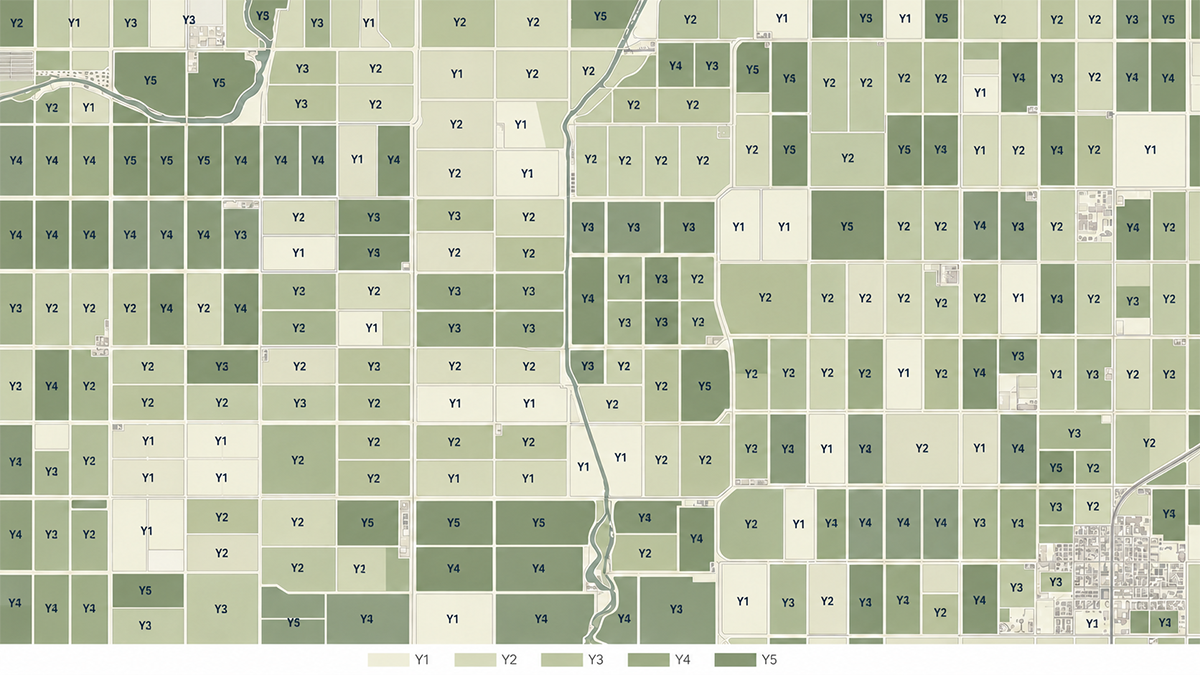
The result was a phased five-year portfolio plan. The 100-field map below is illustrative (five percent of the real field count) and uses color to designate proposed renewal years.
A Multi-Year Renewal Schedule Worth $15M/yr
Management received a dated renewal plan rather than a magic yield cutoff. The company’s own CFO said the improvement to the planting methodology should be measured at roughly $15 million per year, against about $500 million of gross revenue in a business that runs at very low margin. The best year for each field depended on its own expected recovery, quality, cost, and location, and on what the other 1,999 fields were doing. The same logic applies to any aging asset portfolio: replacement should be based on the marginal value of waiting versus resetting now.
See other Agribusiness: Livestock Feed · Enzymes · Orange Juice · Milk